Showing posts with label teaching. Show all posts

Thursday, March 5, 2015

Get Used to It!


My time as a teacher in Japan only stretches another fifteen days. I’ve broken protocol and started telling my students that I’ll be leaving. Neither my wife nor our coworker supports this. I guess they’re rip-the-bandage-off-at-once kind of people. Responses vary, and I’m beginning to think I should’ve just pulled a Houdini in two weeks.   

Most of the students only ask about the new teacher. “Boy or girl?” “Is she pretty?” “How old are they?” Most agreed a female teacher would greatly improve their current predicament. One group of seven year old boys, possibly resentful they were going to have to learn how to terrorize a new teacher effectively, spent the class period drawing piles of smiling poop on the board. Neither the promise of candy or threats in a foreign tongue could deter this behavior. Two of my adult classes stole my thunder by actually quitting the class moments before I was going to break the news. “Sorry, Joe. Last class.” I tried to explain that I was leaving too and that they didn’t need to apologize but they just bowed and made their exit while I tried not to feel abandoned.  

Not all responses were bad though. Two thirteen year old boys who refuse to speak English unless I let them play basketball cheered me up. Haruto asked me how many more classes we’d have together and when I told him it was only three.  He repeated “Oh no! Oh no! Oh no! Oh no!” on loop for the next three minutes. That’s the most English I’ve ever heard him say, and it hit me right in the feelz. Takumi, not as prone to bizarre and emotional outbreaks said nothing, only smiled. Haruto called him careless (We’d been studying adjectives but I didn’t have the heart to correct him) but Takumi only dug through a notebook. He found what he was looking for, looked me straight in the eyes and told me, “Good friends live on in the heart.”

I did my best not to blubber like a grandmother in front of two boys only interested in throwing a deflated rubber ball in a dented metal can.

But the reaction that touched me the most was from the first person I told. I let slip that I was leaving because Akira informed me he was going to be opening a Japanese style steak house. As in a place that only seats six people, and he will personally prepare every bite of food for his diners. He wants to open in November, he just needs a location. My mouth watering I confessed that I wouldn’t get to try his steak because I was leaving in a month for America. He frowned at me and reached for his dictionary. After thumbing around he said, “I got used to you.”

What a compliment. But there’s a lot in those words. Maybe it means I’ve adapted to life in Japan that such a simple statement could mean so much. But I guess that’s the truth of life. We only grow accustomed to the little things that make us comfortable. Coffee, how people say hello, all the little stuff you never notice unless you have to go without.
I had got used to life here, and damnit Japan, I mean it.

Tuesday, September 9, 2014

Sing Karaoke with your Students


These people got drunk and sang karaoke with his students this weekend. This is their story, only names have been changed.
 
Most of the week, I teach at a public school in the morning. I teach thirty minute lessons to about twenty-five kindergarteners. We sing the alphabet, play vocabulary games and their favorite, ‘TPR’ where we all march around the room chanting, “walking,” or “swimming” and the kids act out the verb. This is a great time for them to follow me and bury their heads in my butt (one kid per cheek). No amount of pleading can dissuade them from this task. They march along, chanting “flying, flying” as their skull applies gentle pressure to my gluteus maximus.

Most classes aren’t like that though. Most classes are at the private school I work for, and take place in the afternoon, once the kids are out of school and presumably tired out from all that butt massaging.

Our school divides the students by age and speaking ability, so most of my elementary students are all within a few years of each other in age, but may speak better English than some adults. As teachers everywhere know, it’s impossible to have a class of truly the same level, and that’s true even in my small classes.

One group has an eight year old, Yuki, who can speak English better than most adults. He’s grouped with the soul of a seventy year old man in the body of a nine year old, Rento-2, who is beyond polite and always perfectly clean, and an eleven year old, Rento-1 (the nicknames they gave themselves) who is one the dirtiest children I have ever seen. I have watched life forms evolve from the stains on his shirt. I don’t think Rento-1’s parents don’t care; I think Rento is proud of his stains. Cleanliness is very important in Japan (you have no idea), yet there’s a popular legend of a samurai who wandered the country, never washing his hair or clothes. I think Rento embodies this legend. He’s independent and not interested in social norms. For example Rento-1 always refuses my stamps--once kids get 100 stamps they get a present. I think he doesn’t want anyone to have anything on him. His stains are his way of showing he won’t conform.

All three of them are good kids, but Yuki’s English is far beyond either of the Rentos. Class consists of me teaching around ten new vocabulary words, then practicing speaking, spelling, and simple sentences. This takes the Rentos (and most students) a few weeks. Yuki never needs to hear a word more than once to memorize it. He spends class time giggling uncontrollably while he absorbs English like a sponge. He can copy anything I say flawlessly, like “Yuki be respectful or you’re not getting any stamps.” Even his grammar is impressive.  A popular question for my students is “what’s your favorite food?” To which they respond, “My favorite food is French fry.” Just that formula can be difficult for them, and we practice it endlessly with different topics, but Yuki will respond with varying phrases like, “I like tomatoes,” or “Sushi is delicious.” He should be bumped up, but considering that he already laughs at a struggling eleven year-old’s pronunciation, it’s probably not a good idea.

If I moved him into Kosuke’s class, Kosuke would probably die. Kosuke is eleven, overweight, and likes reading and French fries. He had a pet bacterium but it died. He told me of his loss by miming pouring out a bowl of water. He is THE master of a Japanese thinking technique in which, if you need to remember something, you sharply inhale over closed teeth. This creates a sound something like the last of a milkshake being sucked through a straw. Charming.

Kosuke is in a class with one other student, Ko, whose disinterest in English rivals my own disinterest in learning Japanese. Ko’s favorite day in class was when one of my other level six students missed her own class and had to come to theirs. Asami almost always wears tank tops (fairly uncommon) and short shorts (unbelievably commonplace), which Ko didn’t fail to notice. “How are you doing?” he asked in English, grinning ear to ear. “I’m tired,” she told him, then asked Kosuke how he was doing. “I’M FINE THANK YOU HOW ARE YOU?” he yelled. Ko didn’t mind asking her about her favorite animals and her hobbies, but Kosuke was glad the next week when things went back to normal.

Normally I teach Asami the same day as I teach two of my highest level students, Despair and Delight. They’re about fifteen, and have impressive English vocabularies, but basically refuse to use them. We finished their textbook, and I asked my coworker what to with them next.

“Ugh, those two, just get them to talk.”

About what?

“About anything.”

I tried for about a month (4 classes) and had to give up. I tried everything. I’d tell stories, offer candy in exchange for words, play games, bring music, I even let them make the curriculum. The curriculum thing worked for one class. They wanted to talk about Life. Great. There’s a lot of material there.

So, what’s important in life?

“Health,” Delight said. Health, and she smiled and nodded like she’d just solved the problem. Delight loves everything. She is oppressively positive. When her friend’s house was damaged from the flood in August, Delight was happy her friend had been able to stay the night with her. Delight wants to work in an airport so she can meet people and practice her English by giving one word directions. She likes Harry Potter, fruit, and playing the piano. She baffles me.

I turned to Despair and asked the same question.

“Purpose,” she said and slumped down in her chair.

Wow! Great answer.

I didn’t know her well yet, and asked the next question without thinking.

What’s your purpose?

She shook her head. “No purpose. Mother has purpose for me.”

Oh dear this wasn’t going well, private lessons are supposed to be fun, not existential probing of the familial structure.

You play guitar right? Maybe art can be your purpose. The two of you can start a band. Ha ha ha…

She shook her head, “I can never be good enough. I am not talented. Music is not my purpose.”

A bold statement for a girl who idolizes One Direction. I’m sure she’s already surpassed their music ability, but that didn’t seem like the right thing to say. I tried to comfort her.

You know, even I don’t know my purpose, many people don’t figure out their purpose until a lot later in life.

Despair shook her head, consumed by the future her mother has planned for her. In the States, that ‘thirty-is-the-new-twenty’ thing works, but not in Japan. As soon as students are in middle school, they’re expected to work incredibly hard to get into a good high school (all of which all require entrance exams) and then either start a career, go to college, or get married. I don’t know which possibility was in Despair’s future, but I know it’s not waiting tables, sleeping until eleven and figuring it all out later.

By the time Japanese students have made it through school and into my adults Intro-B class, they seem to be hard working but happy. They always tell me they’re tired, but that seems to be a respectable way to feel. They are all keep very busy schedules. They all have careers (some more than one, Kirito is a hair stylist and owns a curry and French toast restaurant) and hobbies they’re proud of. The word hobby has always seemed dirty to me, like something you do to waste time, but here, whether your hobby is cycling, boxing or videogames, its talked about with a head held high (it doesn’t hurt that all of those are one person’s hobbies). Some dote on their children, some garden or play volleyball, but all of my students love to drink.

Which brings us back to the restaurant. Ken and Kirito came out and sat across from my boss and me. They poured my beer whenever my glass neared empty, one of the most charming of all Japanese customs. They were drinking shochu, basically Japanese moon shine, and trying to convince me to have some because it wouldn’t give me hangover. Ken was going to cycle up a mountain at four AM, and he was drinking plenty. We stuffed ourselves on sashimi and fried vegetables, then left for karaoke. The karaoke spot our boss liked was full, so he called it a night and the rest of us followed Ken to a snack bar.  

They greeted us warmly, and put a half full bottle of whiskey at our table. I think Ken had previously purchased it, and we just paid for the hostess’s conversation skills and drinking pouring ability. She kept the whiskey coming, and applauded excitedly when us Americans sang “Bohemian Rhapsody” and “Rocky Raccoon.”

Our students say songs in Japanese, and a hit by the Carpenters, but eventually we stumbled out, too drunk to sing. We hailed a cab and explained that, no, we weren’t tourists, and to please take us home. I woke hours later, happy I wasn’t climbing a mountain with the monstrous hangover had. Maybe I should’ve tried the shochu.

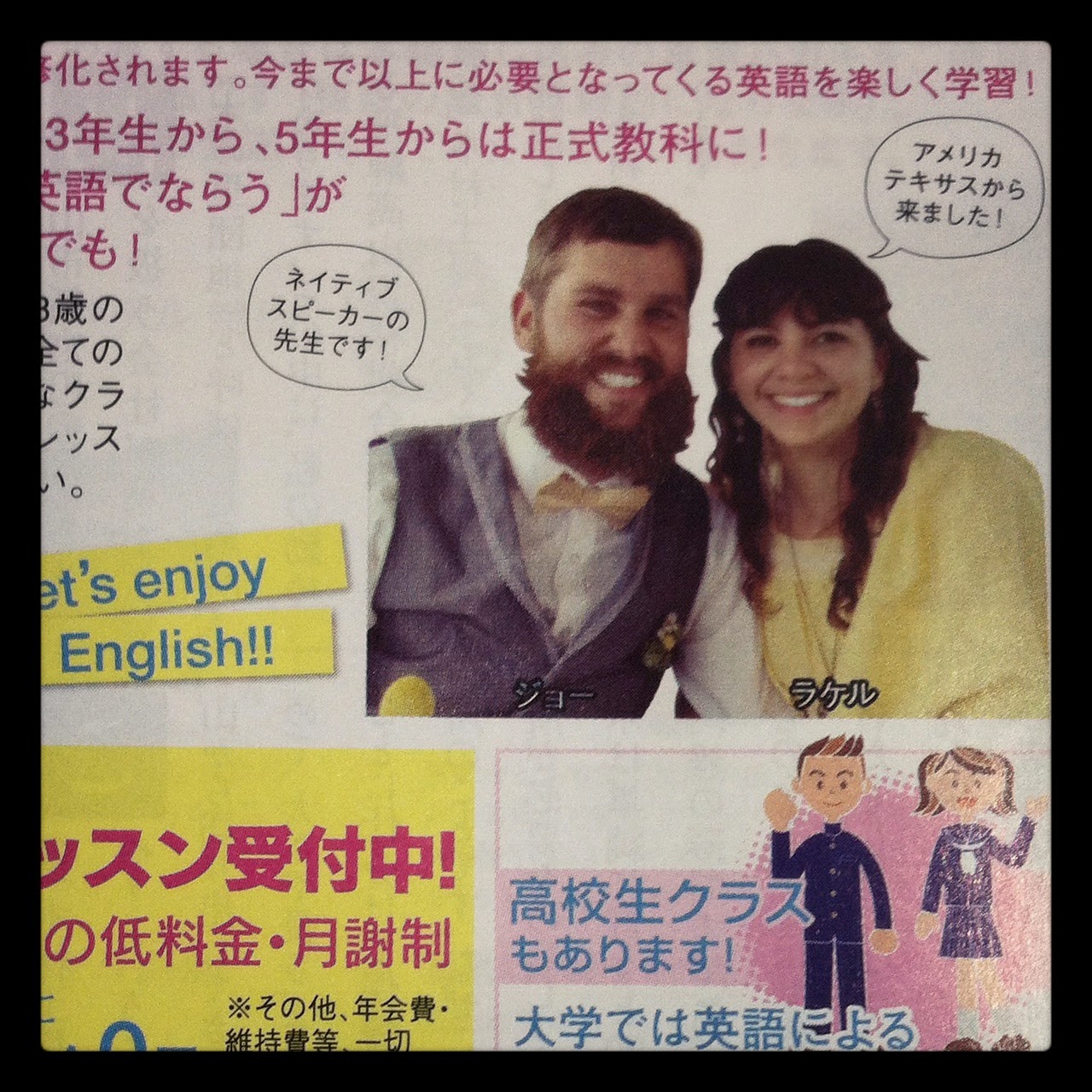
Joe Darris Mitchell lives in Takayama Japan and teaches English. If you want to read more about him teaching, click here. If you want to read more drinking stories, click here forAustralians, or here for Israelis.
Of you enjoyed this post, please +1 and share with those who’d appreciate it!

Sunday, June 29, 2014

Notes on Teaching in Japan


I think teaching English is a lot of Westerners’ ticket into Japan. We’re inherently qualified, we feel confident in our abilities to speak our own language, and understanding Japanese is sort of a disadvantage because it allows the students to speak Japanese and not English (much like living in Takayama, a tourist town, allows me to speak English and not learn any Japanese). The few English speakers that I’ve met either teach English, or started out teaching English and then changed professions once they obtained a work visa.

I was a teacher in the States, and while I’m definitely not one of those holier-than-though teachers who think children are little miracles and the guiding light of our future, I do enjoy teaching the little bastards. I learned from my mentor, Jorgan, that teaching is a lot of fun, and that turning a roomful of animals into (somewhat) civilized human beings can be a very rewarding process. Don’t get me wrong, if my novel goes platinum I’d quit as soon as the school year’s over (speaking of which you can get it on your ereader at smashwords) but I don’t mind teaching, and can’t think of a way I’d rather pay the bills. So I think I’m a little different than the average English teacher, because I saw how things were done in the States. And believe me, there are more than a few differences between teaching in the States and teaching in Japan.

An American I met here summed it up nicely: “Japan and America are backwards.”

It’s true in a lot of ways. In Japan you drive on the opposite side of the road, vegetable gardens in your front yard is normal, sushi is cheap, and hamburgers are expensive. On the train, elderly people actually stand up so kids can sit down. In the States, I can’t count the times I’ve seen adults blithely ignore an elderly person on the bus while they yammer away on their phone. Men don’t even hold doors for women anymore. Some do, guys trying to get laid and pastors, but I think manners are generally thrown out the window when college starts.

That’s the biggest difference between Japan and the United States. In Japan, adults are very polite, and the kids are rude. In the United States, children are expected to be very well behaved, and the adults get a free pass. Don’t get me wrong, I’ve worked with some real terrors, but in general the kids in the States are expected to be seen and not heard. Getting school clothes dirty is a frowned upon, as is running around a classroom screaming “Ancho! Ancho!” with your hands clasped together and ramming them up your teacher’s ass-crack.

That’s all OK in Japan. The playgrounds have mud pits, where the children are encouraged to either roll mud into spheres (with their hands!) or dig trenches and generally make a mess.  “Ancho” is a real thing, and while its frowned upon, most of the teachers seem to think its endearing, like a kid yelling out the correct answer without raising his hand. In the States, if I high fived a student, there was a fear of legal repercussions, I probably could have been hung if a child’s hand found its way between my cheeks. Here, I’m expected to pick the kids up, twirl them around, endlessly rub their heads and let them crawl on me like a jungle gym.

The first day in the classroom was beyond enlightening. My boss finished his lesson (a nice euphemism for dancing around and chanting in English for 30 minutes) and left the room to go help with lunch. All of a sudden a 5 year old Japanese boy came running out of the bathroom butt-naked. As in nothing. No shirt. No underwear. He wasn’t even wearing socks. He started shaking his little wiener for the class to see and to my horror they all began to strip. Boys and girls just dropped trow and let it all hang out. Within a minute I was surrounded by a 30 naked Japanese children.

What was going to happen when my boss, or even worse, their actual teacher came back? My life in Japanese prison flashed before my eyes. Would I be confined to a wicker cage, or forced to kneel on pointed tiles as they laid stone blocks upon my thighs? Would someone stick bamboo shoots under my fingernails or did that task now belong to a robot?
 

My boss chose that moment to return. I clutched my passport and looked for the exits. I was on the second floor, but maybe I could shimmy down some bamboo. No such luck. I was trapped. Goodbye Japan, hello hari-kari.

“Today’s a splash day, would you help them get dressed if they ask?”

He turned and left without batting an eye.

Oh. Duh. They just had to change clothes. They’re just a bunch of naked kids, so what? They all paid more attention to my gold toenail polish than to each other’s naked butts. And rightly so. We’re all the same after all, especially at that age. After a little thought (and a couple of beers) it seems like a more natural view of nudity than we have in the United States.

I’ve been in the same position in Texas, a roomful of kids had to change into swimsuits to go splash around outside, but it was a much more frightening experience. The first grade teacher ushered out all the girls while she eyed me like mother hen eyes a fox. It was just us boys, but not one of them hurried to change. Instead they all scurried to the corners of the classroom to change clothes in shame. Is it really a good thing for a six year to have issues with his body image?

It’s not like there’s people naked on the streets in Japan. Again, I think Japanese adults look more put together and professional than American adults. I’ve never seen anyone in their pajamas at the grocery store here, something that’s commonplace in Austin.

There’s a shift in Junior High, when kids start to go through puberty I guess. My junior high students are very serious about school, and always tell me how tired they are from hours of school, extracurricular activities and the endless English classes (Japanese students are required to take English grammar tests that I’m sure I would fail). They don’t climb on me, or threaten me with anchos and they would never change clothes in public.

But the kids get to act like kids. They catch bugs, jump in puddles, and smear their teachers with all sorts of goop.

I think it’s impossible to go through life always being well behaved. Manners and customs have their place, but I think we all need to rebel against them to appreciate why they exist at all. It’s part of life, we have to exercise the animal in us, so we know when it’s time to shape up and act civilized, damn it.

I like that the kids in Japan get to be the animals. After all, they don’t know any better, they’re kids. They have plenty of time to mature, and they do. They grow from little ancho-ing banshees into incredibly polite adults, and isn’t that better than wearing pajamas at the grocery store?

Joe Darris currently lives in Japan with his darling wife. If you enjoyed this story, please share with your friends on your favorite social media!