Showing posts with label festival. Show all posts

Wednesday, February 25, 2015

The Magical Ice Lord Yushi

An ice demon approached me scowling and carrying a banner. He was dressed straight from the legends and smiled with too many teeth. I called my friends over only to find that they too had been confronted by one of these ice demons, their King in fact, the Magical Ice Lord Yushi!

But let me back track, you’re probably lost.

When the water molecule falls below 0 degrees Celcius (a convenient temperature to be sure) it begins to exhibit curious properties. When a people evolve around this molecule in its solid state, they too begin to exhibit quirks and curiosities of their own.

A curiosity of my own caused me to pile into a car to see this man named Yushi. I’d been told he eats bears, owns a mountain, and creates an ice forest every year. When invited, I always say yes to meeting people like this. My wife on the other hand, had no qualms about ignoring a Magical Ice Lord. When I asked Raquel if she wanted to join me, she simply chortled and snuggled deeper under our heated coffee table. 

The lake never knew what hit it... Because it's a lake.
So I crammed into a car with too many foreigners and away we went to meet a man on his mountain, stopping only to throw snowballs into a frozen lake.

The ice forest began ordinarily enough. There were trees, and snow on them! It didn’t really seem like the kind of place that a Magical Ice Lord would want to live, but around a bend were confronted with a wall of ice.

It was 5 meters tall, and had swallowed up birch and pine in its hunger to expand. It looked like the prototype for the wall built to keep out the white walkers. Alex and I proceeded to insult it.

Lord Yushi's Ice Forest.
“That’s ice all right.”

“Looks cold.”

Giggle-giggle-snort-giggle-giggle.

I edged through the entry way into the festival proper. Nothing in Japan is free, but I’ve spent 300 yen in far worse ways. I once hiked 4 kilometers to find that the entrance to the sacred pond I sought cost 300 yen to enter (as in go past the fence not swim). I remember laughing at the foolish Japanese who’d approach the gate, peak around a corner, and leave, too cheap to shell out 3 coins! I paid the entrance and realized that yeah, it was just a stupid pond and I’d been ripped off. They didn’t even have none o’ dem fancy colored fish or tiny lil’ trees or nothin!

The ice forest was more impressive. It rose up on either side of snowy promenade for maybe a kilometer. Fathers dragged children on sleds, vendors sold roast fish, and tourists snapped pictures with Japanese White Walkers.

Eric introduced Yushi to me and like any good tourist I threw my arm around him and took a selfie. This was his family’s land, and every year the whole clan through this party and dressed up as beasts and priests and…a giant corncob? I looked to Nolico for an explanation but she only shrugged and mumbled something about this area growing good corn.

I swear, in Japan, everything and nothing is sacred. Here we were in this crazy winter realm, a land of demons and bears and ancient priests, and this dude was dressed up to hock corn. They weren’t even selling any corn! I don’t get it, but I guess I’m alone in this sentiment, for Alex giggled and asked if I’d take his picture with the stupid corn guy.
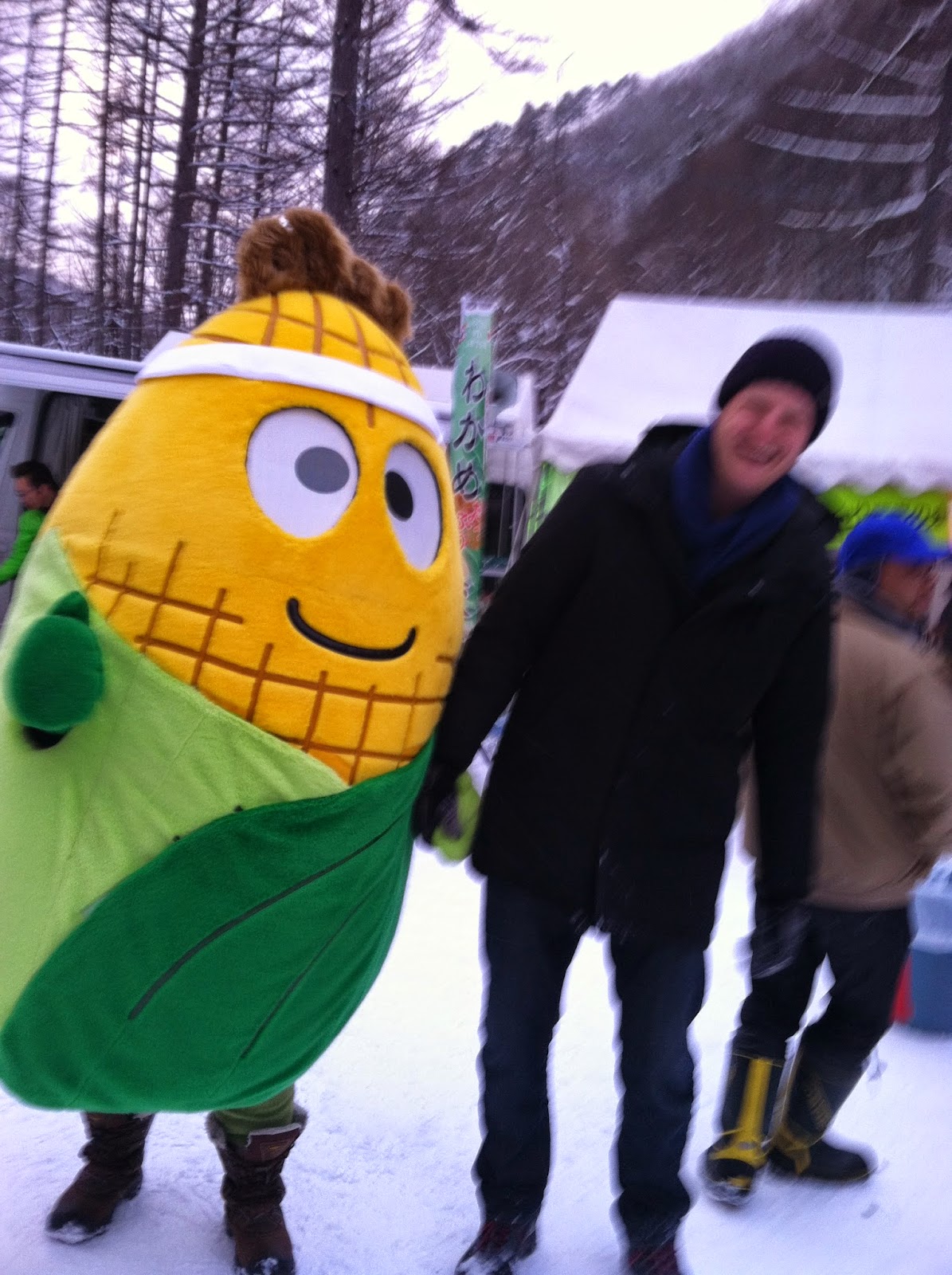
God he loved that corn...
I tried a new fish (always a highlight for me) and we all wandered around and took pictures until the sun went down and the cold set in. Lord Yushi saw us shivering and offered to let us use his hotel’s Onsen. That’s right, this mountain king even had his own volcanic hot tub. I nodded dumbly, this sounded too good to be true! And indeed it was, for though Lord Yushi was indeed generous, he was also hosting a festival and wasn’t really in the position to be giving guided tours. Instead he led us to the winter games.

Somehow Eric, Alex and I all ended up not only competing but in the same heat, even though most of the competitors were children or their grandparents. But with a grand prize of 3,000 yen on the way (about 30 bucks) we were not going to let those little bastards make off with our loot. So when told we had 60 seconds to stack a tray with as many hazelnuts as we could, we jostled for position as we neared the bucket of hazelnuts, and stacked those trays to the sky. I lost to Eric, but he was promptly beaten by some dumb kid’s mom.

Our heads hung low, we watched the rest of the competition until it was Nolico’s turn. She’d been watching the competition closely, and had quite the strategy for stacking nuts. She wobbled back with more hazelnuts in her tray than I thought possible. She ended up coming in second place! We patted her on the back and congratulated her until we found out that not only did she win 2,000 yen, every competitor received 500! We had drinking money! Alex struggled with the economics of it (“But how can they make money if they give away more than the entrance fee!?”) but when Nolico bought us hot sake he stopped complaining.

Maybe One day I'll be an Ice Lord too...
Everyone lined up to make mochi after that. To make mochi you smash perfectly good rice with an enormous hammer while a man dressed like priest kneads the dough between strikes. All the while an ice demon humps the person trying not to smash the preist’s fingers. I was shocked everyone in Lord Yushi’s family still had all their fingers. Mochi hasn’t really made the jump to America. I’m not sure why, It translates roughly to fucking-disgusting-rice-goo-that’s-impossible-to-chew-and-even-harder-to-swallow. But most people seem to like it.

Humped and tired, we knew it was time to leave when the band (playing on a stage made of ice) started playing a jazzy rendition of “let it Go” on saxophone. I made awful puns about “the cold not bothering me anyway” until actually it did start to bother me and we got in the car and drove home, happy to have a designated driver, and happier to have heat.


Tuesday, October 21, 2014

The Horror of the Lion-dancers


A Lion-dancer nibbles the brain of a defenseless child.
This weekend we witnessed the horror of a Lion-dance festival. Thirty beasts moved in unsettling synchronized steps, then turned their snapping jaws on the crowd. Some of the adults offered their own flesh, but the most delicious morsels, the children, were unwillingly sacrificed to the monsters. Kids watched in mute horror as parents carried screaming children to the jaws of the hungry, dancing lions. Dazed, the children didn’t think to protest until their own parents lifted them and carried them to their doom. They’d scream, punch with their tiny little fists, cry for help, but to no avail. The only escape was through the jaws of one these beasts. The Lion-dancers would nibble at the screaming child’s brains, their parents would laugh and maybe snap a picture, and then the ordeal was over.
Do you want a snack? Parents would ask their traumatized little ones.
I needed this festival. As the trees turn orange, and Halloween approaches, I’ve been feeling a bit homesick. There’s still bags of cheap candy in the stores in Japan, but everyone assures me that, no, there will be no trick-or-treaters. I always hiked miles as a kid, jacked on high fructose corn syrup, daring my friends to go grab candy from the abandoned house with a strobe light flashing eerily, only to pee my pants as a masked killer rushed us from the hedges. Later, too old to trick-or-treat I dressed as a scarecrow on my front porch and grabbed unsuspecting victims or simply hid inside the door, waiting for the perfect moment to strike as my wife doled out candy.  So alas, I was quite sad I wouldn’t get to scare any children this year.
 
It seems that duty lies with the Lion-dancers.
My first experience with the Lion-dancers was at the kindergarten where I teach. The teachers stopped class and dragged the kids out to playground while the principal locked the doors to prevent the kids from hiding in the building. Six men came out, dressed in traditional Japanese garb. They played an eerie melody on shrill flutes that wormed its way into my head. One child was already crying, and soon the whole school was sobbing. They knew what was coming. Only I was ignorant of the terror.
The Lion-dancers made their entrance. As for costumes, I’ve seen far more convincing at Haunted Houses. A Lion-dancer is obviously two men, a sheet, and a red lion/dragon/dog mask with a moveable jaw that one of the dancers snaps in time to the music. The Lion-dancers hopped and their jaws snapped to the beat. The kids tried to scoot away, but their cruel teachers, (myself among them) didn’t let them.
“They’re just people,” I cooed in a foreign tongue.
Then the Lion-dancers rushed forward. The kids ran. Teachers stopped as many as they could. I managed to snag a few and held them down as the Lion-dancers approached, jaws snapping. We took turns dragging the kids forward towards their hungry jaws. The Lion-dancers would politely nibble each child’s skull--melting them into a sobbing wreck--then abandon them for their next victim.
I actually had to teach them English after this traumatizing experience. The kids looked like hell. Their hair was tangled, their clothes dirty from running and falling in the path of the Lion-dancers. They sang the alphabet through tear streaked faces. They needed a nap or a stiff drink.
I told this story to one my most gifted students and she explained the horrific custom. A bite from the Lion-dancers bestows wisdom, so schools hire them to terrorize the children and parents drag their children to festivals to be bitten. Lion-dancers were soon going to visit her high school and she doubted she’d be able to face them. When she was little, a Lion-dancer came to her door and chased her through her house until it cornered her under her bed. Her parents dragged her out and offered their screaming child to the monster. This student is seventeen years old and she’s still terrified of the things. The terror of the experience must be proportional to the intelligence bestowed, because she’s one of my brightest students, and I have heard no story more terrifying.
Back at the festival, the Lions left and were replaced with a slow procession of children. They moved
The young samurai of the festival
across the stage in a hypnotic dance. There were tiny girls in kimonos, boys with spears, hammers and umbrellas, and samurai. After the trauma of the Lion dance, their performance was relaxing and absorbing. They moved with the surety of tradition, each verse another step in their dance.
These weren’t the same kids whose parents drag them to these festival. These were performers, a part of the festival, perhaps the children of the Lion-dancers. These were the children who made the festival exist, the kids carrying the tradition. But there were only so many of them. The rest were from all over the city, brought here to experience the purest of emotions, terror, and in doing so, perhaps plant the seed of distrust in their parents that would one day grow into full-fledged rebellion and drive them from their homes. After all, they weren’t part of any traditional dance, they were victims of the slaughter. City kids with videogames and ramen noodle shops and no roots to their past, save this one, the one that might drive them farther from tradition than their own terrified parents already are.
But I don’t think it will.

There’s something about terror that transcends culture; people the world over value fear. Be it the Brothers Grimm, Freddy Krueger or Lion-dancers, adults get a sick pleasure from traumatizing their children. Parents, camp counselors and big brothers the world over recognize this. Some part of us wants to be scared, that’s why we ask to hear ghost stories and to see scary movies. Fear awakens something in us, something primal, but perhaps it must be balanced by silly masks and obvious costumes, so we can still sleep at night in a house with the true masters or terror: our parents. 
Joe Darris Mitchell lives in Takayama Japan with darling wife, and looks forward to carving pumpkins and handing out candy despite the lack of trick-or-treaters, damn it. Read more about a genius Japanese students, or other weird Japanese festivals. And please +1 if you liked this story!  
 

Tuesday, October 14, 2014

Takayama Matsuri


The shrill trill of flutes, ancient yatai, and the greasy smell of festival food all competed for my attention. I had been looking forward to this festival since we arrived in Japan.  

The story goes the emperor of Japan hired carpenters from Takayama to build his palace, as they were the best woodworkers in all of land. And though they built his beautiful home, they were still required to pay heavy taxes. Unhappy with this state-imposed robbery, the carpenters melted all of their money into gold leaf, traded their skill for silk, and made the most beautiful yatai in all of Japan.   

And yet, something about the festival, like much of Japan, is an unspoken bond between the ancient and the modern, (another contradiction for my regular readers). In the states, there are no festivals like this, no ancient rituals to the gods. In the states, people crowd around to see musicians play guitar, while at the Fall Festival, they crowd around to see puppets. And when the puppet fails to swing out to the last rung of the monkey bars, a man in a hood carefully moves it, strings be damned, and the crowd giggles at this failure of ancient technology and snaps pictures on their cell phones.

The old and the new blend together seamlessly in japan. Even the crowd seemed a mix of the centuries; there were tiny children and doting grandparents, uniformed teenagers daring each other to dip their toes in the river, Tokyo fashionistas in too-high heels, and Europeans crowding around the only gyro stand in all of Takayama. Though we were all there ostensibly for the yatai, I think that we, like people throughout the ages, truly enjoy festivals for the food.

This is what my students told me after all. “The best time to go is 10am.”

Really? Why’s that?

“That’s when the food stands open.”

The food was also part ancient tradition and part modern artifice. I, being the foolish foreigner that I am, headed straight for the enormous spiked sea snails an elderly man was grilling. Shocked that I wanted one of these horrifyingly large mollusks, he carefully picked a juicy one and handed it over with a tiny wooden spear for me to gore it with. I wandered off, cradling my meal and looking for my wife. I founder her grinning ear to ear as she held a big, round orange and sucked the juice from it. Drinking orange juice straight from the orange looks like something traditional, but it requires a specialized blender to liquefy the fruit’s insides and not damage the peel. The ancient and modern blended yet again. Eager to show her up with my far more bizarre festival fare, I speared my snail’s firm flesh and took a bite.

It was the most disgusting thing I have ever eaten. Ever. I am not one to be squeamish. I dine on all manner of sea creatures, from unagi to urchin. I’ve eaten cartilage, raw scallops and garden snails by the bucket. I once slaughtered a guinea fowl only to dine upon its heart and gizzards. So I think I’m more adventurous than some (certainly than my wife, who thinks a cucumber on a stick is the epitome of exciting food) but this sea snail was horrible. It was bitter, bitter as the smell of burnt matches. It was huge and impossible to tear apart with my teeth. I’ve had snails before, and always the intestines are removed, but not for this guy. As I gnawed at the snail’s flesh and attempted to force it down my throat, I saw centimeters of curled up blackness approach my mouth. It was too much. I spit it out, ashamed of my shortcomings, and begged my wife for a drink of orange juice.

I gave up on traditional food after that. I queued up with the Europeans for a gyro, bought a bag of tiny pastries that are somewhere between a baked donut and a funnel cake, and a skewer of delicious hida beef. The gyro was strange, the sweets gave me a bellyache, but the hida beef… oh yes. Hida beef is richer than the emperor. Hida beef is succulent rivers of fat between tiny islands of muscle. If hida beef is the solar system, the planets are the meat, and the enormous space in between is grass fed, pampered perfection. Satiated, we went off in search of the parade.

The parade is a fantastic blend of the ancient and the modern. Around a dozen men haul each yatai down narrow Japanese streets. People lined up, eager to see this procession. One man screamed at the rest to get out of the way while a bumbling police officer continued to let cars drive towards the approaching yatai.

Some of the elaborate floats have children perched atop them, some venerated members of the community, but the tallest float had the greatest rider. He perched atop the very tip of the yatai, and did not come down, not even when they tilted the entire structure back on two wheels so they could maneuver it around a corner. He carried a pronged stick, and used it to prevent electrical wires from snagging on elaborate gold sculptures or electrocuting anybody. His presence, more than anything else at the festival, made me appreciate the blend of the ancient and modern. This route has changed little over the years. And yet the festival evolves. It has too. Water damage and theft might have once been the greatest threat to the gods within the floats, but now
this man must ride the yatai to prevent death by electric wire.

And the festival participants take all this in stride. There is no contradiction between the old and the new, no need to silence your cellphone in the presence of the divine. There’s a coexistence between the ancient and the modern here that is as puzzling as it is refreshing. I can see a seven eleven from the temple near my home. Apartment buildings fight rice paddies for space; neither is willing to move, and neither has to. Instead both ways of thought, tradition and progress, grudgingly accept each other and force each other to evolve.

It’s strange and a little unsettling, but it’s beautiful and makes for better festival food than sea snail.
Joe Darris Mitchell lives in Takayama Japan with his darling wife. If you enjoyed this story, why not drunkenly tell your friend about it at the bar, or hit the +1 button?

Read more about Festivals, food, or fun in Japan.

Friday, July 25, 2014

Gion Festival: Eating, Drinking, Collecting


Kyoto holds a false glamor. It’s a tourist town, filled with expensive cameras, sweaty foreigners, and overpriced souvenirs. I’m sure this is unfair, but that’s what I experienced. Kyoto’s power emerges, like a cicada from its mystical slumber, during the festivals.

During the day, Raquel and I went sightseeing like the tourists we were. We saw the Golden Pavilion overrun by Germans and hiked across the city to find Kiyomizudera Temple covered in tarps. The only thing I really liked was Inari Shrine.

Inari Shrine is home to more Torii Gates than any other place in Japan. There’s thousands of them, each paid for by someone (corporations included) eager to appease the gods. It might sound hokey, but I like it. Millions of dollars are spent to be part of this place’s power, and you can feel it. It’s not just me either, more people were praying at Inari than anywhere else I’ve been in Japan.

Walking up the mountain path, through the gates, is glorious. Tourists huddle here and there, and they add to the magic of the place. Because of their presence, you truly notice the moments when you round a bend and find no one. No family. No Germans. No National Geographic Photographers. All of a sudden you’re alone, with 1000 Torii Gates to yourself. When this happened to us, we’d do what any good tourists would do, I waxed philosophic about the timelessness and beauty and blah blah blah while Raquel shamelessly shot videos on her phone.

The real fun of Kyoto comes out at the festivals.

Raquel was eager for street food and I was excited to buy tallboys of Asahi “The Extra” and drink them on the street.

Crowds overflowed the Gion festival. People of all ages were dressed in Kimonos: beautiful couples, young women with exquisite hair and self-conscious men with that special look of pride and foolishness that only comes when a man knows he’s doing something to get laid. There were respectable older women taking pictures of floats, single twenty-somethings preening around for other single twenty-somethings, grandiose old men, adorable children and more beautiful women. There were so many people that one point that crowd simply stopped moving, completely, for 3 long minutes. No one seemed to know why, but we were all glad to escape the crush.

Everyone was there to see the floats. The floats are astounding. They tower over the crowds, decked in lights. Each is unique, hundreds of years old and home to the Kami, Japanese deities somewhere between a God and a spirit. Each float had a stamp, and for the low low price of 100 yen, I too could have a stamp in my notebook! This confirmed my suspicion that collecting is a deep rooted part of the Japanese psyche. Figurines, pokemon, stamps of the Kami, they collect it all. I, a former pokemaster, queued up with the locals. I got seven stamps before I got too drunk to continue, and I’m damn proud of that entire statement.
Meanwhile, Raquel was hunting for food. We bought ayu earlier (read more) but we also ate stir-fried noodles, crepe on a stick, tentacle on a stick, meat on a stick, and Raquel’s favorite,cucumber on a stick. It was lightly salted and served ice cold. She was in heaven.  


Other entertainment of the night included catching fish with paper nets, a task as impossible as it sounds. I am a pet addict, and could not pass up the opportunity. Drunk, I mangled my paper net in seconds. I resorted to dunking my bowl into the kiddie pool of dying fish. Victorious, the carnie (do you call them carnies in Japan?) bagged my catch and sent me on my way.

Raquel was not happy.

“What are you going to do with those stupid fish?” she fumed.

I laughed and boasted but quickly realized she was right. In my drunken stupor I believed I could get them back to Takayama without issue, but once there I’d need to buy a pump, a filter…

“Darling, do we have any big glass bowls or vases?”

“You are not putting those stupid fish in a Kitchen bowl.”

These fish were going to eat into my beer money. I needed to dump them, and fast.

Adults are for the most part, rational, sane human beings, so I targeted the exception: parents. “Sumimasen!” I’d yell to a dad already carrying a bag of fish and hold up my catch. They cursed me with cold smiles, then politely declined before their children realized I was offering them more heartbreak they’d have to flush down the toilet.

Then, I saw them. A young couple, sitting on the curb, holding plastic bags of water up to the light of a thousand paper lanterns.

Sumimasen!” I said, and held up my bag of fish.

The woman hopped up and held out her own bag, eager to compare our catches. They had turtles. Perfect. Getting turtles at a festival is even more irresponsible than getting fish. This was my moment. I held my fish to my chest, then extended them towards her. From me to you. She scratched her head, careful not to mess up her perfect hair. I repeated the gesture, gave a little bow. Thank the Kami. She understood.

She slowly reached out for my bag of fish. I shoved them into her hands, desperate to be rid of the commitment and the guilt I’d feel at their eventual death.

Arigato Gozaimas!” I yelled, and got the hell out. I glanced back and saw her boyfriend staring at the fish, terrified of all the time and money the little bag implied, of all the work and energy I had escaped, then I lost them to the paper lanterns and silk.

We stumbled back to the hotel, carefree, drunk on irresponsibility and “The Extra,” glad to have experienced Kyoto, and glad to leave.
 

Joe Darris currently lives in Japan with his wife where eats weird things, drinks too much, and generally makes an embaressment of himself. If you enjoyed this story please +1, share and subscribe for more! 

Tuesday, July 22, 2014

Man vs. Fish, Round 2!


Ayu!” Raquel screamed through the throngs of people. We’d found it, the allegedly delicious river fish served whole, complete with guts, brains and bones. Tucked in between a fried noodles place and an ancient Japanese float, home of the Kami, Japanese Gods of Nature, a woman was grilling fresh ayu. Two Japanese teenagers had ordered one of the eight inch fish, caught in a nearby mossy river, then skewered and salted. The chef held their order over a bed of hot coals and carefully turned the fish back and forth before handing it to the young couple. They looked apprehensive as they sized up their meal.
 
Not wanting to get discouraged, I hastily ordered one of the ayu and a beer to wash it down. (My last experience with the fish was anything but pleasant).  The chef selected an ayu, already crusted in salt, and lowered it over the bed of coals. To my dismay, she grilled the fish for less than a minute before handing it to me. Wait! I wanted to say. That can’t be enough time to fully cook the viscera! But my Japanese skills are laughable, so instead I politely nodded and paid her for the fish.


I sized up the ayu. Its bony face stared back at me with eyes crusted in salt. Its fins looked like they’d choke me as soon as I tried to swallow one. Unsure of where to start, I bit into the plumpest part of the fish, its belly. Hot guts flowed into my mouth. It was salty and fishy and, actually, not that bad. Am I chewing intestines? I pondered as I masticated the strangely textured organs. Do fish even have intestines?

A note to eaters of ayu: Don’t look into the fish’s abdomen. I did, and immediately regretted it.  At the back of an empty cavity, dotted with brown and green specks of fish guts, the spine and ribs joined together, daring me to eat the bony cage. Sanity returned before I ate the fish’s eyes or brains, and I remembered: people normally eat the sides of the fish, not the guts! I sunk my teeth into the ayu’s tiny flank.

Oishi! It was salty and rich! Reminiscent of salmon perhaps, but different, delicious! The bones added a nice crunchy texture to the tasty meat. Half the fish was gone before I remembered to offer my wife a bite. She nibbled the ayu’s side and smiled. This really was a tasty fish!

I enjoyed every bite of that delicious ayu (the spine and fins were crunchy and especially delicious) until I chomped into the gills. They tasted how I imagine the filter of poorly maintained fish tank would taste, like rotten algae and fish shit. Isn’t that what gills are? They’re oxygen filters. Eating gills is like eating the lungs from a chain-smoking monkey. I gagged at the thought, then chugged beer, desperate to be rid of the vile taste.
 
The nearby Japanese teenagers noticed my disgust and politely giggled to eachother. I wanted to explain, possibly through pantomime, that the fish was delicious, just the gills were nasty, but I didn’t bother. I think everyone likes that feeling of belonging, of being home. That feeling that one only really gets when foreigners get excited or confused or even repulsed by something the locals take for granted. So I said nothing, and let them belong.
Instead I wandered off in search of the Gods and the delicious sights and sounds the mortals of the festival were offering them.
 
Joe Darris currently lives in Japan. If you enjoyed this story, please +1 and share with your friends and family!